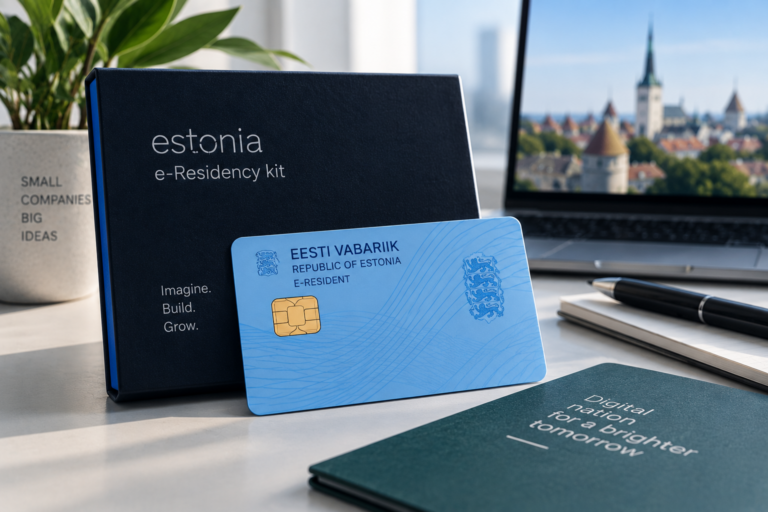
Estonia’s e-Residency makes it possible to access Estonian e-services and manage an Estonian company remotely — but it is not citizenship, a visa, a residence permit or tax residency.
What exactly is Estonia’s e-Residency?
The name e-Residency can be confusing.
It sounds like a type of residency. In reality, it is something quite different.
Estonia’s e-Residency is a government-issued digital identity and status for non-residents that provides access to Estonia’s digital services and business environment. It allows you to authenticate yourself online, digitally sign documents and use Estonian e-services from abroad.
For entrepreneurs, one of its most useful applications is the ability to establish and manage an Estonian company remotely.
But becoming an e-resident does not mean becoming a resident of Estonia.
That distinction is fundamental.
What can you actually do with e-Residency?
Your e-Residency digital ID can be used to access a range of Estonian public and private digital services.
For example, you can:
- digitally sign documents;
- authenticate yourself in Estonian e-services;
- access the Estonian Business Register;
- access Estonia’s e-Tax environment;
- establish and manage an Estonian company online;
- authorise other people to act on your behalf in certain Estonian e-services.
Digital signatures made using the card can be legally binding.
For an international entrepreneur, this can make company administration considerably easier.
Instead of travelling to Estonia whenever a corporate document needs to be signed, much of the administration can be handled remotely.
What e-Residency is not
This is arguably more important than understanding what e-Residency does.
It is not citizenship.
Becoming an e-resident does not make you an Estonian citizen.
It does not change your existing citizenship and it is not a pathway to Estonian citizenship.
It is not a residence permit.
Despite the name, e-Residency does not give you the right to live in Estonia.
If you want to relocate to Estonia, normal immigration and residence rules apply.
It is not a visa.
The e-Residency card is not a travel document.
It does not give you the right to enter Estonia or another EU country if you would otherwise require a visa.
It is not personal tax residency.
Becoming an e-resident does not automatically make you an Estonian tax resident.
Your personal tax residency continues to depend on the relevant tax rules — for example, where you live and your connections with a country.
EMTA explicitly treats an e-resident as a non-resident for Estonian personal tax purposes unless the normal conditions for Estonian tax residency are separately met.
It is not a bank account.
Receiving an e-Residency card does not give you an Estonian bank account.
Banks and payment institutions have their own onboarding, KYC and AML requirements and decide independently whether to accept a customer.
This is particularly important for founders who assume that e-Residency automatically solves banking.
It does not.
Do you need e-Residency to own an Estonian company?
A useful distinction is that e-Residency is a digital-access solution, not a special legal type of company.
There is no separate legal entity called an “e-Residency company”. An OÜ established by an e-resident is simply an Estonian company.
For an international founder who wants to establish and manage an Estonian company remotely, however, e-Residency can make the process considerably more practical.
It provides the digital identity needed to interact conveniently with much of Estonia’s digital infrastructure.
If your objective is specifically to operate an Estonian company from abroad, this is one of the main reasons to consider applying.
Who is e-Residency best suited for?
The official programme highlights international and location-independent entrepreneurs in particular.
It can make sense for:
- freelancers and consultants;
- software and technology businesses;
- digital service businesses;
- remote entrepreneurs;
- founders serving customers internationally;
- people managing an international or remote team.
The common factor is not necessarily the industry.
It is that the business benefits from being administered digitally and does not require the founder to be physically present in Estonia for day-to-day company management.
Who may benefit less from e-Residency?
E-Residency is not automatically the best solution simply because you can apply for it.
Suppose you live in one country, perform all your work there, employ people there and serve mainly local customers there.
Creating an Estonian company does not make those facts disappear.
Similarly, if your main objective is:
- obtaining permission to live in the EU;
- reducing your personal tax simply by becoming an e-resident;
- obtaining a guaranteed EU bank account;
- creating a company with no ongoing compliance obligations;
then e-Residency does not provide those things.
The company structure should fit the reality of the business.
Doing business in Estonia: should you open an Estonian company? →
Does e-Residency mean 0% tax?
No.
This is one of the most important misconceptions to avoid.
E-Residency itself does not determine where you personally pay tax. EMTA states that an e-resident is not automatically an Estonian tax resident and that e-Residency does not exempt a person from taxation elsewhere.
An Estonian company incorporated under Estonian law is an Estonian resident company.
But that still does not mean that Estonia must be the only country with taxing rights over its activities.
EMTA specifically notes that if the business is conducted abroad or the company is managed from outside Estonia, taxation may also arise in another country.
So these are three separate questions:
Where are you personally tax resident?
Where is your company resident?
Where does the company actually conduct business and create taxable presence?
E-Residency answers none of these questions by itself.
Does e-Residency give you an Estonian personal identification code?
Yes.
When e-Residency is granted, you receive an Estonian personal identification code.
This number identifies you in Estonian systems and remains associated with you.
But having an Estonian personal identification code does not itself mean that you live in Estonia or are an Estonian tax resident.
Again, digital identity and physical/tax residency are separate concepts.
How does the digital ID work?
The physical e-Residency card contains a smart chip and digital certificates.
You receive security codes that perform different functions:
- PIN1 is used for authentication;
- PIN2 is used for digital signing;
- PUK can be used in connection with blocked PIN codes.
The digital signature can carry the same legal effect as a handwritten signature.
This is one of the practical reasons the system is useful for remote company management.
How do you apply for e-Residency?
The application itself is made online through the Estonian Police and Border Guard Board’s application environment.
Applicants generally need to provide documentation including:
- a copy of a valid identity document;
- a recent digital passport photo;
- information requested in the application.
Applications are subject to background checks and approval is not automatic.
If approved, you must collect the digital ID in person from an official pickup location and provide fingerprints. Someone else cannot collect it for you.
That means the programme is digital, but obtaining the physical digital-ID kit still has an in-person step.
Does e-Residency guarantee that you can open a company?
E-Residency gives you access to the digital infrastructure needed to perform many company-related actions.
But it should not be interpreted as blanket approval for any business activity.
Regulated industries may require licences or additional registrations, and company formation itself must comply with Estonian law.
There can also be restrictions on eligibility for e-Residency itself. Estonia requires applicants to have a legitimate purpose and lawful intentions, and applications can be refused on specified grounds.
Does e-Residency guarantee business banking?
No.
This deserves repeating because it can materially affect a founder’s plans.
Banks and payment institutions perform their own due diligence.
They may consider factors such as:
- where you live;
- your citizenship;
- your business model;
- countries where you operate;
- customers and suppliers;
- expected transaction volumes;
- source of funds.
The official e-Residency programme explicitly states that e-Residency does not guarantee access to banking or payment services.
So banking should be investigated as part of your company setup — not after assuming approval is automatic.
Do you receive an Estonian business address?
No.
The e-Residency status itself does not provide a physical business address in Estonia.
Your company still needs to satisfy the applicable legal-address requirements, and depending on the setup you may need an Estonian licensed contact person.
These services are normally arranged separately from the e-Residency application.
What happens after you receive e-Residency?
If your objective is to establish an Estonian OÜ, receiving the digital ID is only the beginning.
A typical next sequence is:
- Decide how the company will be structured.
- Arrange the necessary legal address/contact-person solution.
- Register the OÜ.
- Set up business banking or payment accounts.
- Arrange accounting.
- Review VAT and other tax obligations.
- Maintain the company’s ongoing reporting and compliance.
How to register a company in Estonia as a foreigner →
How much does e-Residency and an Estonian company cost?
It is useful to separate the cost of e-Residency itself from the cost of running the company.
The company can have separate costs for registration, legal address/contact person, accounting, banking and other services.
This is why a low incorporation fee alone tells you very little about the actual cost of the structure.
See the full cost of starting and running an Estonian OÜ →
The simplest way to think about e-Residency
Think of e-Residency as a digital key.
It gives you secure access to Estonia’s digital environment.
That key can make it possible to establish and administer an Estonian business remotely, sign documents and interact with Estonian e-services.
But the key does not determine:
- where you can live;
- where you can travel;
- where you personally pay tax;
- whether another country can tax your business;
- whether a bank will accept you;
- whether your business needs licences or registrations.
Once that distinction is clear, e-Residency becomes much easier to understand.
It is primarily an administrative and digital-access tool, not an immigration or tax-residency programme.
Frequently asked questions
Is e-Residency the same as Estonian residency?
No. E-Residency is a digital status and identity. It does not give you physical residency rights in Estonia.
Can I live in Estonia with e-Residency?
Not on the basis of e-Residency alone. If you need permission to live in Estonia, the relevant immigration and residence rules apply separately.
Can I travel to Estonia with an e-Residency card?
The e-Residency card is not a travel document and does not replace a passport or visa.
Does e-Residency make me an Estonian tax resident?
No. Personal tax residency is determined separately. EMTA explicitly states that an e-resident is not automatically an Estonian tax resident.
Can I open an Estonian company with e-Residency?
One of the main uses of e-Residency is to enable international founders to establish and manage an Estonian company digitally.
Does e-Residency guarantee a bank account?
No. Banks and payment providers apply their own eligibility, KYC and AML requirements.
Is an e-Residency company a special type of company?
No. There is no separate legal form called an e-Residency company. An OÜ established by an e-resident is an Estonian company like another OÜ.
Thinking about starting an Estonian company?
See what the setup involves, what it really costs and which services you may need before choosing a formation provider. See how to start an Estonian company →