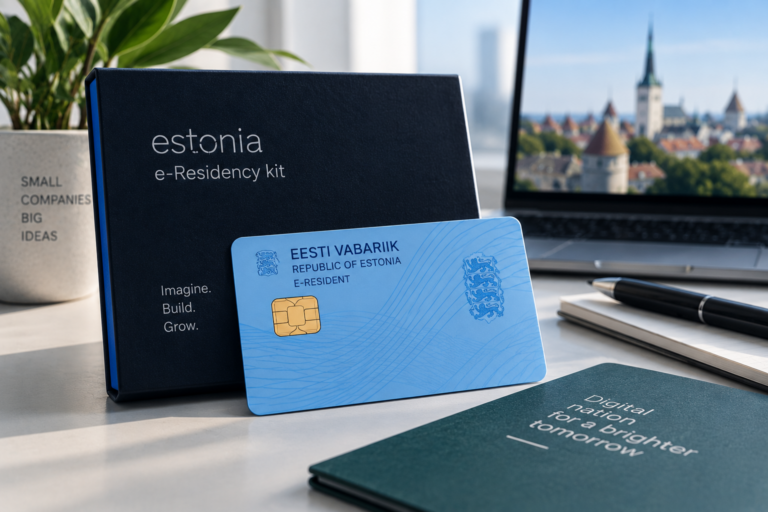
What is e-Residency?
Estonian e-Residency is a government-issued digital identity for people who are not Estonian residents. It lets you authenticate yourself in Estonian e-services and sign documents digitally. For international founders, that can make it much easier to manage an Estonian company remotely.
It is important to separate e-Residency from immigration and tax status. E-Residency is not a visa, residence permit or citizenship, and it does not automatically make you an Estonian tax resident.
Do you need e-Residency to start an Estonian OÜ?
No. You can own an Estonian company without being an e-resident. However, e-Residency is the standard route for founders who want to establish and manage the company remotely using Estonia’s digital services.
If your goal is to run an Estonian company from abroad, e-Residency is usually most useful when you want to sign documents yourself, use the e-Business Register and manage ongoing administration without relying on a local representative for every step.
What changes in March 2027?
Estonia is working on remote biometric identity verification for e-Residency. Under Bill 905 SE, identity verification is planned to move to remote biometric checks from March 2027. The applicant’s biometric data and travel-document information would be compared remotely with data in national databases.
This is the part that can make the application process much more digital because applicants would no longer need the same in-person biometric step. However, it is not yet the same as a completely cardless e-Residency.
Important timing: remote biometric identity verification is planned from March 2027. The transition to a cardless e-identification tool is planned from March 2028.
As of September 2026, the proposal is still in the Riigikogu legislative process, so these dates should be treated as planned rather than final until the law is adopted.
How does the application work now?
- Submit the e-Residency application online and choose a pickup location.
- Wait for the background check and approval.
- After the card is produced and delivered, collect the digital ID in person at an authorised pickup location.
- Activate the card and install the required ID software.
- When you are ready to incorporate, compare setup providers in our Estonia company formation comparison.
The e-Residency programme currently describes the application itself as online, but the digital ID card still needs to be collected in person.
What e-Residency does not give you
- It does not give you the right to live or travel in Estonia or the EU.
- It does not automatically make you or your company tax resident only in Estonia.
- It does not guarantee that a bank or fintech provider will open an account for you.
- It does not remove the need for accounting, annual reporting or tax compliance.
When is e-Residency especially useful?
| Situation | How useful is e-Residency? |
|---|---|
| You live outside Estonia and want to manage an OÜ yourself | Usually very useful |
| You need to sign Estonian company documents remotely | Very useful |
| You only want to invest in or own shares in an Estonian company | Not always necessary |
| You expect e-Residency to change your personal tax residency | It does not do this |
What should you arrange after e-Residency?
The digital identity is only one part of the setup. Most foreign founders will also need to think about company formation, a legal address or contact person, a business account and ongoing accounting.
Compare the company setup, not just the application
See formation providers side by side, including setup cost, accounting, legal address and annual reporting.