Estonia offers a broad mix of public grants, EU funding and support programmes for companies that are investing, developing products, entering new markets or improving their operations. The challenge is usually not finding a programme name — it is understanding which funding is realistic for your company, what costs are eligible and whether the application is worth the time.
This guide gives founders and finance teams a practical way to approach business grants in Estonia without treating every funding opportunity as “free money”.
- Early-stage or innovative company: look first at innovation, product development and R&D support.
- Established SME investing in growth: check digitalisation, automation, energy efficiency and export programmes.
- International company with an Estonian entity: confirm that the activity, team, costs and economic impact actually qualify in Estonia.
- Project already started: be careful — many programmes do not finance costs incurred before the application or funding decision.
Where can Estonian companies find grants and funding?
There is no single grant that suits every company. Funding normally depends on the purpose of the project, the size and age of the business, the sector, the location of the activity and the type of expenditure.
| Funding source | Typical use | What to check first |
|---|---|---|
| Estonian Business and Innovation Agency (EIS) | Innovation, product development, digitalisation, export and business development | Open calls, company eligibility, project location, eligible expenditure and co-financing |
| European Union programmes | R&D, innovation, sustainability, cross-border projects and sector-specific programmes | Whether the application is direct to the EU or through an Estonian implementing body |
| Environmental Investment Centre (KIK) | Environmental, resource-efficiency and climate-related investments | Environmental impact requirements and eligible project categories |
| Local and sector-specific programmes | Regional development, creative industries, training or specialised investments | Location, sector, company size and programme-specific restrictions |
| Loans, guarantees and blended funding | Projects where a grant covers only part of the investment | Own-financing requirement, cash flow and whether external financing is allowed |
Start with the official programme pages and the current call conditions. Grant schemes change, open and close, so the decisive source is always the current funding regulation or application notice — not an old article or a previous funding round.
What makes a project a good candidate for grant funding?
A strong funding case usually starts with a business project that makes sense even without the grant. The grant should accelerate or expand the project, not be the only reason for doing it.
Typical fundable themes include product or technology development, research and development, automation, digitalisation, international growth, energy efficiency, sustainability, training and investments that create measurable economic impact. However, the exact scope varies from programme to programme.
Before spending significant time on an application, check five things:
- Eligibility. Does your company, project, sector and location meet the programme rules?
- Timing. Can you apply before signing contracts, ordering equipment or starting the funded activity?
- Eligible costs. Are salaries, software, equipment, subcontracting or other planned costs actually eligible?
- Own financing. Can the company finance the non-grant portion and bridge the period before reimbursement?
- Measurable outcome. Can you clearly explain what changes because of the project — for example revenue, exports, productivity, jobs, technology readiness or environmental impact?
What should international founders and e-residents pay attention to?
Having an Estonian company does not automatically make every Estonian grant available. Funding bodies may look at where the real activity takes place, where employees or development work are located, what economic impact the project creates in Estonia and whether the company has the resources to complete the project.
For an international founder, the practical questions are often:
- Is the project activity actually carried out by the Estonian company?
- Are the relevant employees, contractors, assets or development activities connected to Estonia?
- Does the company have sufficient own financing and liquidity?
- Are related-party costs or foreign subcontractors allowed?
- Can the company provide reliable management accounts and supporting documents?
This is where accounting and grant management meet. A project can be commercially excellent but still create problems later if payroll, invoices, project periods or cost allocation are not documented in the format required by the funding terms.
Other public funding sources in Estonia
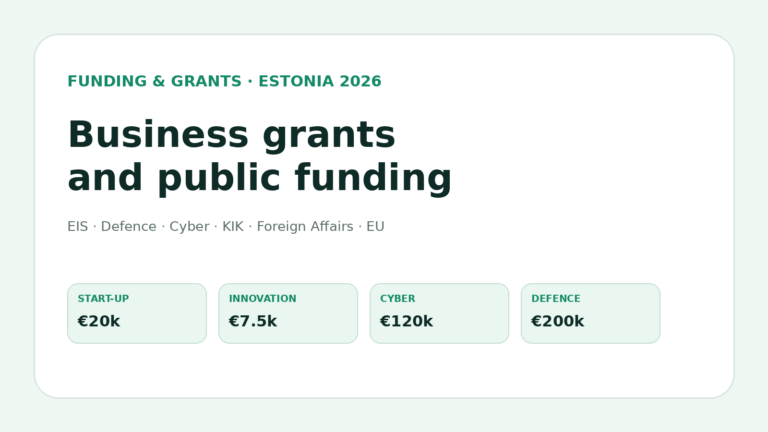
This open measure supports organisations newly subject to Estonia’s NIS2-related cybersecurity requirements. Maximum support is €120,000. A cybersecurity roadmap can receive €5,000 at 100% support; roadmap-based development can receive €10,000–€100,000 at 50%; and auditing can receive up to €20,000 at 50%.
Not all business support in Estonia comes through EIS. Depending on your sector and project, funding or market-entry support may also come through the Ministry of Defence, Ministry of Foreign Affairs, KIK, RIA-linked programmes, RTK-managed EU funds and direct EU programmes.
| Funding body / programme | 2026 support | Status / timing | Who it is for | Type of support |
|---|---|---|---|---|
| Ministry of Defence – Defence Industry Development Projects Competition | Up to €200,000 per project; up to 40% of eligible project costs | 2026 application deadline was 19 August 2026; decisions expected in October | Estonian defence and dual-use companies developing innovative defence products and technologies, typically TRL 4–7 | Direct development grant |
| European Defence Fund (EDF) + Estonian co-financing | Varies by EDF call and national co-financing rules | Call-specific | Defence and dual-use companies participating in European collaborative R&D and capability-development projects | EU grant + possible national co-financing |
| Ministry of Foreign Affairs – Business Diplomacy | No fixed company grant | Ongoing | Estonian companies entering foreign markets, joining business delegations or seeking embassy and diplomatic-network support | Market-entry and export support, not a standard cash grant |
| Ministry of Foreign Affairs – Ukraine Business Portal | Depends on international tenders, donor programmes and EU instruments | Ongoing; opportunity-specific | Companies in construction, energy, digitalisation, infrastructure, services and reconstruction-related sectors | Procurement, donor funding and international programme access |
| Ministry of Foreign Affairs – Business Delegation Project Support | Up to €100,000; support rate up to 80% | 2026 organiser competition already awarded | Primarily non-profit organisations organising business-diplomacy activities and delegations, rather than individual companies | Project support; useful to companies indirectly through funded delegations |
| KIK – Circular Economy Programme | 2026 programme budget varies by activity; EMAS unit support up to €10,000 | EMAS / EU Ecolabel applications open until 31 October 2026 or until budget is exhausted | Companies implementing environmental management systems or applying for EU Ecolabel, where eligibility conditions are met | Environmental certification / project support |
| RIA + EIS – Cybersecurity Innovation Support | Programme-specific | 2026 programme available through EIS/RIA-linked support | Cybersecurity companies developing new products and services | Innovation / product-development support |
| RTK – EU structural and regional funding | Depends on the specific call | Multiple calls open and close throughout the year | Companies that fit a particular regional, energy, innovation, employment or investment measure | EU structural-fund grant |
| Direct EU programmes | Programme-specific; can range from small innovation grants to multi-million-euro consortium projects | Call-specific | R&D, deep-tech, climate, digital, defence, space and cross-border consortium projects | Direct EU funding via programmes such as Horizon Europe, Digital Europe and EDF |
EIS and the Ministry of Defence can provide direct development support to companies. The Ministry of Foreign Affairs often provides market-access, delegation, procurement and donor-programme routes instead. RTK and EU portals administer many call-specific funds, while KIK support is tied to environmental objectives and eligibility conditions.
Which route should you check first?
Ministry of Defence, EDF, EIS defence calls
RIA/EIS cyber innovation support, Digital Europe, Horizon Europe
Ministry of Foreign Affairs business diplomacy, EIS export programmes
Foreign Ministry Ukraine business portal, donor tenders, EU and international financial institutions
KIK, Modernisation Fund and EU climate measures
RTK-managed structural-fund and regional calls
BestFit tip: classify the project first by objective — product development, defence, cyber, export, environment, regional investment or international reconstruction — and then look for the funding authority. This is much faster than browsing grant lists without a project category.
How to prepare before applying
A good application is much easier when the financial structure is prepared before the form is filled in. Build a simple project budget that separates personnel, external services, software, equipment and other direct costs. Mark which costs you expect to be eligible and which costs the company will finance itself.
Then prepare a short project narrative answering four questions: what is the current problem, what will the project change, why is the proposed solution credible, and how will the result be measured?
For accounting, decide in advance how grant-related expenditure will be tagged. A dedicated project code or cost centre makes later reporting, reconciliations and audits significantly easier. Keep contracts, invoices, payment evidence, payroll calculations, time records and procurement documentation together from the beginning.
- Current programme rules reviewed
- Project has not been started too early
- Budget and financing plan prepared
- Eligible and non-eligible costs separated
- Accounting/project code structure agreed
- Evidence and document flow defined
- Reporting responsibilities assigned
Grant, loan or own financing?
A grant is useful when the project matches the policy objective of the programme and the administrative work is proportionate to the benefit. For smaller investments, a grant application can sometimes cost more in management time than it saves. For larger development projects, a combination of own funds, financing and grant support may be more realistic.
Do not choose a project because a grant exists. Choose the project first, then find the funding instrument that best fits it.
Where to check current opportunities
Because programmes change frequently, use official sources for the final eligibility check. Useful starting points include the Estonian Business and Innovation Agency, the EU Funding & Tenders Portal and programme-specific Estonian implementing bodies.
BestFit tip: shortlist funding opportunities by project purpose first — for example R&D, export, digitalisation or energy efficiency — and only then compare grant percentage, deadlines and reporting burden. This removes a large number of unsuitable programmes immediately.
Need help choosing the right setup?
BestFit helps Estonian companies compare the services and tools they need for accounting, banking, legal support, software and business operations.